How it works Race strategy
Race strategy
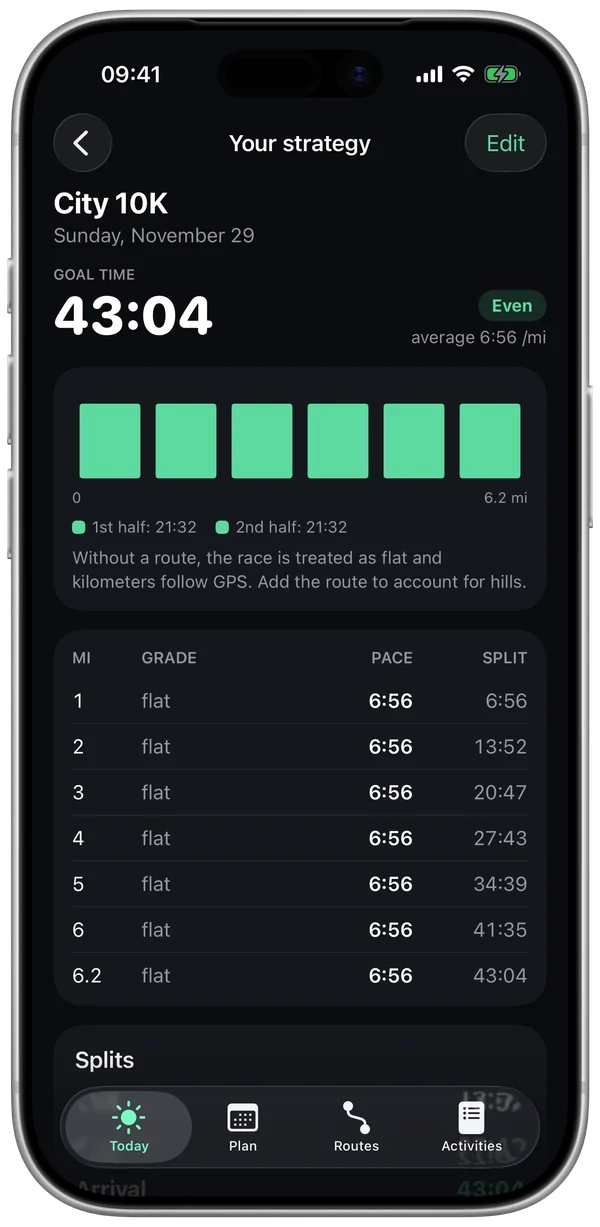
For your race or any route: a pace for every mile based on the hills and your target time, then on-wrist guidance that tells you if you're on schedule, without ever pushing you to make it all up at once.
What Stamio uses
- Your course profile: a GPX file, a Strava route or a route from your library, scaled to the race's official distance.
- Your target time: your plan's goal, today's fitness on this course, or a time you pick.
- During the race: your position on the course, your pace and your time, measured by your watch.
How it's calculated
- 1
The course, in small pieces
The course is cut into segments a few dozen meters long, each with its grade, taken from the file's elevation.
- 2
What each grade costs
Running uphill costs more energy, downhill a little less: that's the published relationship between grade and the energy cost of running. Stamio fine-tuned it on real runs recorded on Apple Watch, and the downhill gain is capped on steep descents.
- 3
Your race style
"Even" holds the same effort start to finish; "Finish faster" starts a little more conservatively to finish a little faster. You can also set the start, how you take the hills, and a crowded start. For the marathon, a small fatigue margin is built in for the final miles.
- 4
Target time, to the second
All paces are adjusted together so they add up to exactly your target time: each mile's pace, its splits, and what the elevation costs you vs. flat ground.
During the race
- On race day, or when you pick its route, the strategy shows up on your watch's start screen, already checked.
- When you follow the route, miles are the course's, not the GPS's: mile 10 hits at the mile 10 marker and your gap doesn't drift.
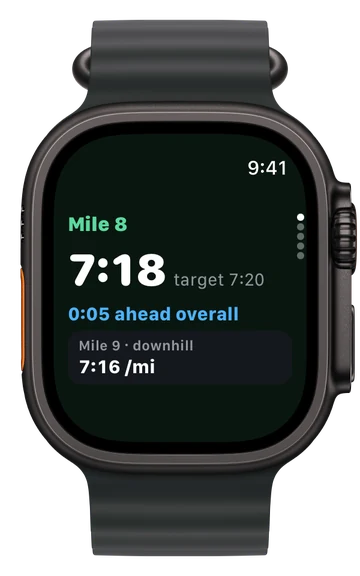
- The Strategy page shows your pace, target pace, gap in words and color, your spot on the profile, and your projected finish; the Upcoming page shows the next miles.
- At every mile, a screen and a voice: your time, your total gap and the pace for the next mile.
- If you're behind, the target pace stays put: the projected finish simply tells the truth. Auto-pause is off, so your gap stays accurate at aid stations.
What can throw it off
- A file with no elevation, or rough elevation: the race is treated as flat, and Stamio lets you know.
- A file longer or shorter than the race: it's scaled to the race distance; if they're more than a few percent apart, Stamio asks which one to trust.
- Wind, heat or a packed start: they're not in the profile. The "Crowded start" setting plans a slower first mile.
- Very steep climbs (over 15%): pace means little there, so Stamio plans a power hike and a time for the climb.
What you can set
- The race: the one in your plan, one of your routes, or just a distance (treated as flat).
- Target time, strategy ("Even" or "Finish faster"), start, hills, crowded start.
- On your watch: the callout at every mile, and the Strategy and Upcoming pages in your run screens.
- A printable pace band, so you can run without checking your watch.
How it was checked
The effect of hills was calibrated on 104 runs recorded on Apple Watch, comparing uphill and downhill pace at a steady heart rate, then checked run by run.
Just one runner so far: me. The beta will tell the rest.
Questions
What if I fall behind?
The strategy never asks you to make it all up at once: the target pace stays as planned, and the projected finish reflects your real pace. Going out too fast to "bank time" almost always costs you more at the end.
I don't have a file for the course.
Choose "Distance only": the race is treated as flat, and only your pace matters. Miles then follow the GPS.
What about a beginner who just wants to finish?
With a "Just finish" goal, no time is shown: the strategy gives you a comfortable pace for each mile, based on your fitness.
And after the race?
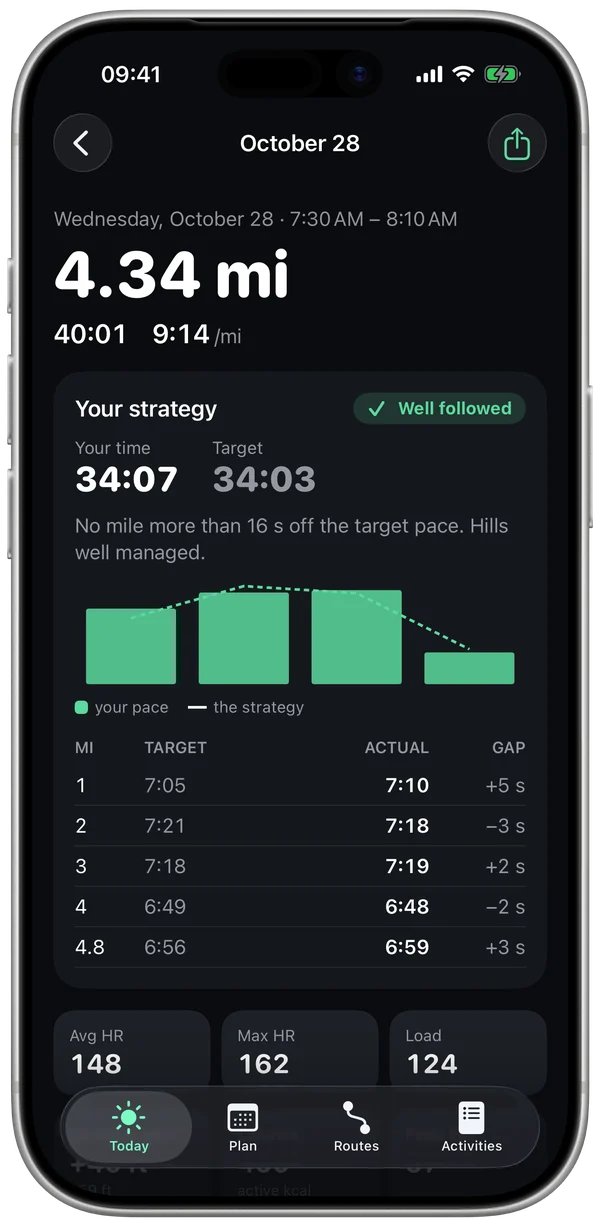
In your race details, each mile is compared with the strategy, using the same ±10-second-per-km range as workout reviews, plus a sentence on how you handled the hills and the finish.
Further reading
- Minetti A. E. et al. (2002), "Energy cost of walking and running at extreme uphill and downhill slopes", Journal of Applied Physiology, 93(3), 1039-1046.
- Abbiss C. R., Laursen P. B. (2008), "Describing and understanding pacing strategies during athletic competition", Sports Medicine, 38(3), 239-252.
A tool to help you prepare, not a promise of a finish time: weather, the actual course and how you feel on the day count too.