How it works Load, status and recovery
Load, training status and recovery
What your workouts ask of your body, whether that dose is making you fitter, and how long you need before the next hard one.
What Stamio uses
- Your heart rate during each workout, relative to your resting HR and max HR.
- Your VO2 max, run after run.
- Your overnight HRV.
How it's calculated
Workout load
Each workout gets a load based on how hard and how long you went, estimated from your heart rate: it's the oxygen debt the effort leaves behind. An easy hour can weigh less than twenty very hard minutes.
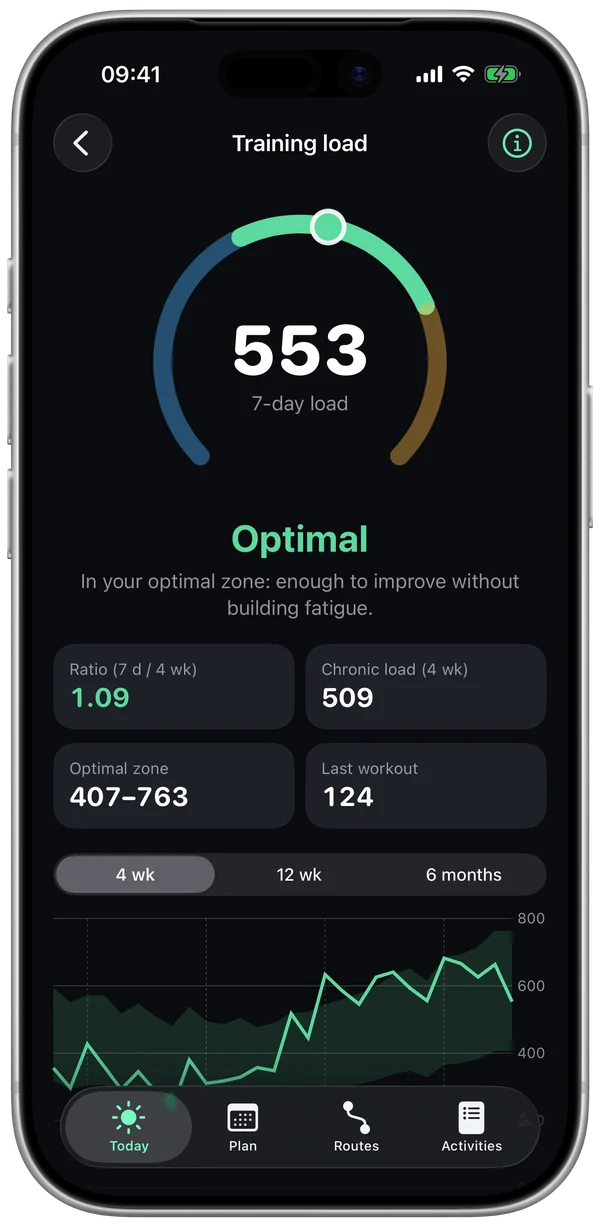
Your 7-day load
It adds up your workouts from the last few days, with the most recent counting more. It's compared with your baseline over the last 4 weeks: between 0.8 and 1.5 times that baseline, you're in your optimal range. Above that, fatigue builds; below it, you're recovering, or losing fitness if it lasts.
The 4-week breakdown
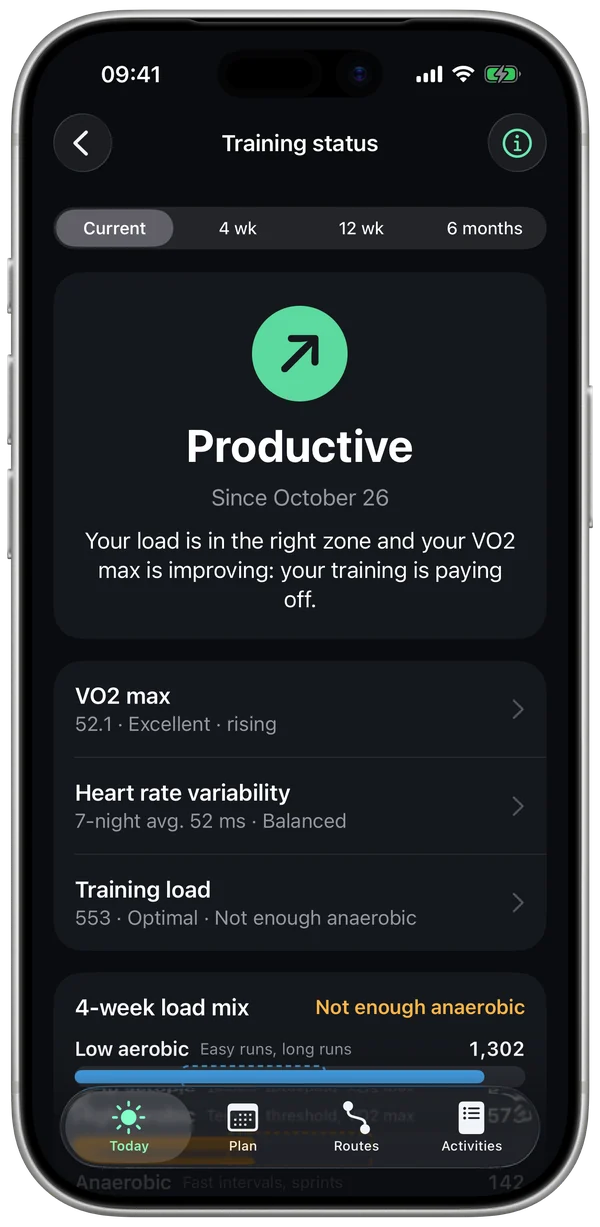
Your load is split into three types: low aerobic (easy runs, long runs), high aerobic (tempo, threshold, VO2 max) and anaerobic (fast intervals, sprints). Stamio tells you when a type is missing or overdone.
Your training status
It combines your VO2 max (your last 2 weeks vs. the 2 before), your 7-day load vs. your baseline, and your overnight HRV. Each situation gets a label: Productive, Maintaining, Recovery, Peaking, Overreaching, Unproductive, Detraining or Strained, plus a sentence on what to do about it.
Your recovery time
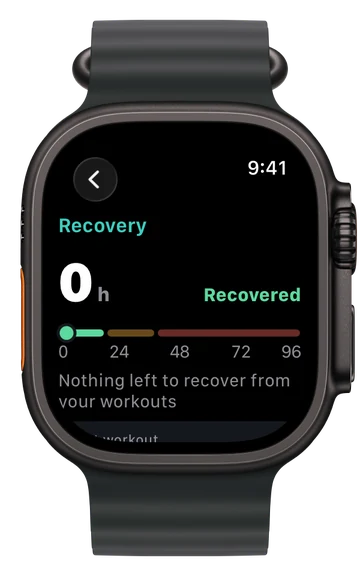
Each workout sets a recovery need based on its effort. The clock counts down one hour every hour. If you're not fully recovered, a new workout adds partly to what's left. When you wake up, a great night shortens the time left and a bad one extends it; a nap speeds it up.
When it changes
- Load and recovery: right after each recorded workout.
- Status: every day, factoring in your workouts, your VO2 max and last night.
- Your first status shows up after about two weeks of running.
- Peaking lasts a few days at most: it's your window to race, not a lasting state.
What can throw it off
- A workout without heart rate: its load is estimated from your pace, more roughly.
- Workouts recorded on another watch: they only count if you turn on "Count workouts from other apps".
- A wrong max HR or resting HR throws off every load. Check them in Settings.
- Serious heat or illness: your heart rate goes up, so does your load, and your VO2 max can dip a little. Your status often shows this as "Unproductive".
What you can set
- Whether to count workouts from other apps.
- Exclude a run with bad heart rate data: it keeps a load estimated from your pace.
- Your resting HR, max HR and heart rate zones.
How it was checked
The 7-day load was calibrated, then checked against a high-end GPS watch worn at the same time: a difference of about 3%.
Just one runner so far: me. The beta will tell the rest.
Questions
I run a lot and I'm "Unproductive". Why?
Your load is normal but your VO2 max is dropping: fatigue, sleep, heat or stress is often behind it. A few lighter days usually get you back to Maintaining or Productive.
Does strength training count?
Yes. Any activity your watch records gets a load from your heart rate, and counts toward your load and recovery.
Why "Strained" when my load is low?
When your overnight HRV is well below your baseline, your body is struggling to recover, whatever your load. Focus on rest, sleep and easy workouts.
Further reading
- Børsheim E., Bahr R. (2003), "Effect of exercise intensity, duration and mode on post-exercise oxygen consumption", Sports Medicine, 33(14), 1037-1060.
- Gabbett T. J. (2016), "The training-injury prevention paradox: should athletes be training smarter and harder?", British Journal of Sports Medicine, 50(5), 273-280.
- Seiler S. (2010), "What is best practice for training intensity and duration distribution in endurance athletes?", International Journal of Sports Physiology and Performance, 5(3), 276-291.
Estimates for training. They don't replace how you feel, or a doctor's advice if you're hurting.