How it works Readiness
Training readiness
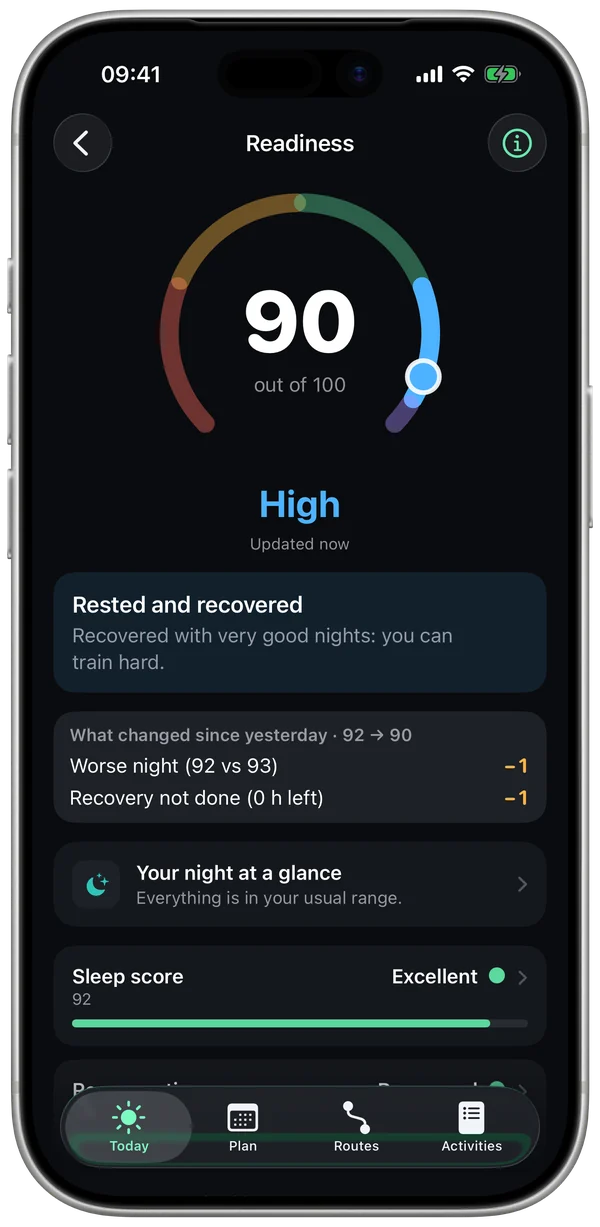
A score out of 100 that tells you whether your body is ready for a hard workout today. It shows up when you wake up, then moves through the day as you recover.
What Stamio uses
- Your night, measured by your watch: duration, sleep stages, heart rate and heart rate variability (HRV).
- Your workouts: the load of each one, taken from your heart rate during the effort.
- Your heart rate at rest during the day, which gives your stress.
How it's calculated
- 1
Six factors, each scored
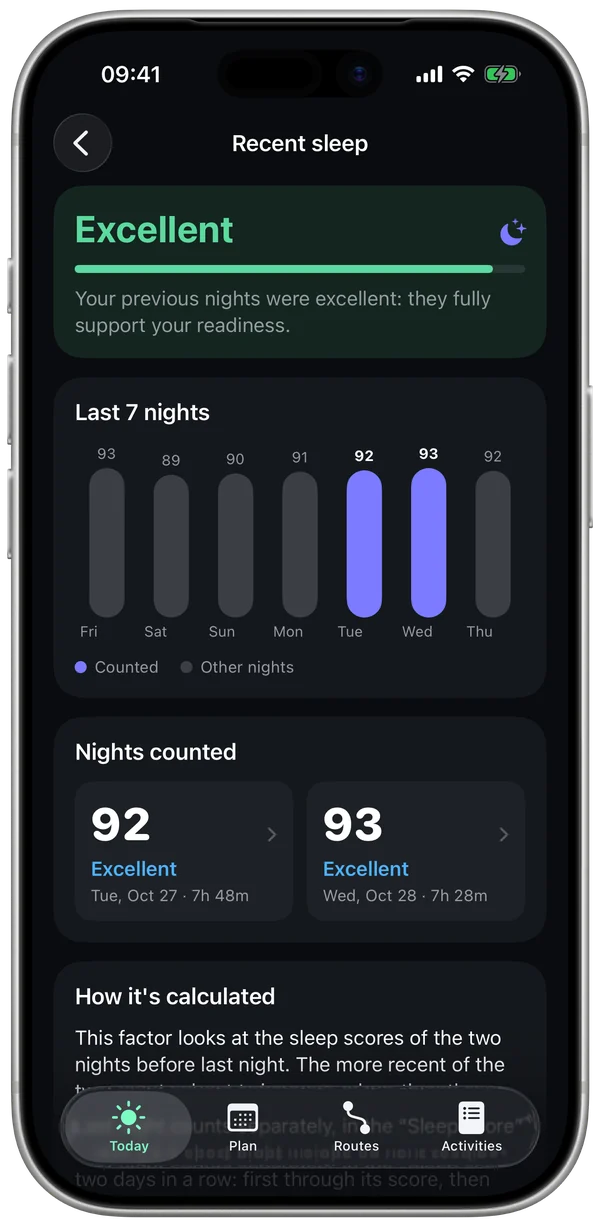
Last night's sleep score, the recovery time you have left after your workouts, your HRV over the week compared with your usual, your load over the last 7 days compared with your usual, your sleep over the two nights before, and your stress over the last three days.
- 2
The weakest factor counts the most
A bad night or a recovery that's far from done caps the score, even if everything else is good. That's on purpose: you don't train hard on just one piece of good news.
- 3
A sentence before the number
The screen starts with your score and what changed since yesterday. Then come the six factors, each with its level and its own screen, and your last 7 days.
- 4
A level to help you decide
Optimal (95 and above) and High (75 to 94): you can train hard. Moderate (50 to 74): a moderate workout. Low (25 to 49) and Poor (below 25): recovery.
When it changes
- When you wake up, as soon as your night has come in from your watch, usually shortly after you get up.
- During the day: a workout lowers it, then it climbs back as your recovery moves along.
- A nap of at least 15 minutes speeds up your recovery.
- After a very intense workout (intervals, a marked anaerobic effect), it stays a little lower for a day or two, beyond the recovery time.
- On the morning of a race in your plan, your night doesn't count: the night before a race is often short and says nothing about your fitness.
What can throw it off
- A night without your watch: the score can't be calculated, only the level shows. Wear your watch at night.
- Workouts done with another watch: they only count in your load if you turn on "Count workouts from other apps".
- Medication that affects your heart rate: your HRV and your load feel it. If you've entered it, Stamio reminds you under "How it's calculated".
- The first few weeks: your HRV needs about three weeks of nights to learn your usual.
What you can set
- Pin readiness to the top of the home screen (long-press its tile), show it on your watch and as a complication.
- Log or confirm a nap (Energy › Naps).
- Your resting HR and max HR, if you know them (Settings › Heart rate and zones).
Questions
It's low, but I feel fine. What should I do?
The score sums up what your body shows, not how you feel. You can do your workout: check which factor is pulling it down. If it's a short night, an easier workout is often the right call.
Why does it drop after my morning workout?
Your workout adds recovery time. The score drops right away, then climbs back hour by hour. It's a sign the workout counted.
What if I don't run?
Readiness also works with other activities recorded by your watch: their load counts just like a run's.
Further reading
- Plews D. J., Laursen P. B., Stanley J., Kilding A. E., Buchheit M. (2013), "Training adaptation and heart rate variability in elite endurance athletes: opening the door to effective monitoring", Sports Medicine, 43(9), 773-781.
- Gabbett T. J. (2016), "The training-injury prevention paradox: should athletes be training smarter and harder?", British Journal of Sports Medicine, 50(5), 273-280.
An estimate for wellness and training. If you have any doubt about your health, talk to a doctor.